
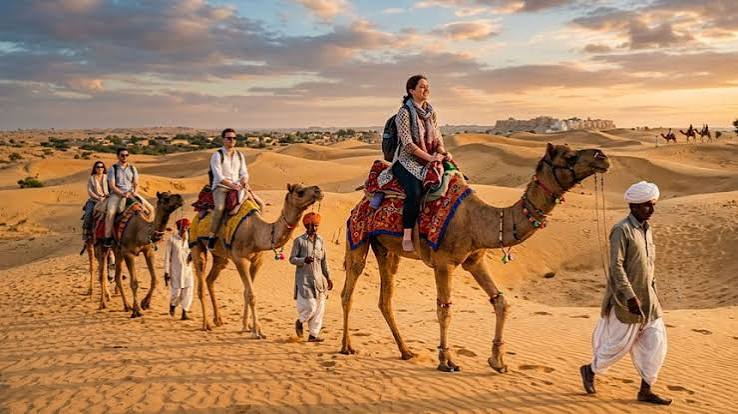

I got to Jaisalmer expecting a fort and a few good photos. What I didn't expect was to spend my best evening of the whole trip sitting cross-legged on a dune, watching a man in a red turban play a kamaicha while the sky turned three different shades of orange. That's the thing about a desert camp night here — you plan for the sand, and you leave remembering the music.
Getting There: The Drive Out to the Dunes
Sam and Khuri, the two dune belts most camps sit near, are both under an hour from the city, so the day starts easy. If you're not driving yourself, sorting a taxi service in Jaisalmer ahead of time saves you the haggling that tends to happen at the fort gate. Most drivers know the camps personally — mine dropped me off with a "ask for Bhanwar Singh, tell him Rakesh sent you," which is a small thing but it made the whole evening feel less like a package tour and more like an actual introduction.
The road out is flat and a little hypnotic. Scrub brush, the odd goat herd, and then, without much warning, the land just opens up into gold.
Sand Dunes by Day
Arriving before sunset was the right call. The dunes in daylight are quieter and less crowded than the postcard version you'd expect — you can actually hear the wind moving the sand, which is a strange sound if you've never heard it before, somewhere between a hiss and a whisper.
Most desert safari Jaisalmer operators run the same basic loop: camels ride out to the higher dunes, a stop for photos, then back down as the light starts to change. I'll be honest, the camel ride itself is a bit rough on the lower back if you're not used to it. Worth it anyway. There's a moment about twenty minutes in, once your camel settles into its rhythm and the noise of the parking lot fades out, where it actually feels like you're somewhere old.
Jeep safaris are the faster option if you'd rather cover more dune territory in less time, and a few camps offer both back to back. I did the camel ride out and the jeep back, which felt like the right split.
Folk Music by Night
This is the part I keep thinking about. Once the sun's down and the tents are lit up, most camps bring out local Manganiar or Langa musicians for a folk set around the bonfire. No stage, no sound system, just a dholak, a kamaicha, and a couple of guys who've clearly been doing this since they were kids.
There was a Rajasthani folk dancer too, spinning with a pot balanced on her head, and at some point the whole thing stopped being a "show" and turned into people just clapping along and getting pulled up to dance badly. I did not dance well. Nobody cared.
Dinner was a simple Rajasthani thali, served buffet-style, eaten sitting on cushions with the fire going. Nothing fancy about the food, honestly, but context does a lot of the work here.
Sleeping Under the Stars
The tents ranged from basic to genuinely plush depending on the camp — some had attached bathrooms and AC, others were closer to a proper Bedouin-style setup with just a mattress and blankets. I'd lean toward the simpler option if you can handle it. Stepping outside the tent at 2 a.m. and seeing that many stars, with zero light pollution for miles, is worth losing a bit of comfort for.
Planning the Rest of the Trip
If a desert night is the highlight, it works best as part of a longer stay rather than a rushed day trip. Most Jaisalmer tour packages bundle the camp night with a day or two in the city covering the fort, Patwon Ki Haveli, and Gadisar Lake, which honestly makes more sense logistically — you're not doing a long drive out and back on the same day you're trying to see havelis.
If you're putting together your own itinerary instead of booking a package, two full days is a reasonable minimum: one for the fort and old city, one for the dunes and the overnight camp.
FAQ
When's the best time to visit Jaisalmer for a desert camp? October to March. Days are warm but manageable, nights get properly cold on the dunes, so pack layers. Summer here is brutal, not really camp weather.
Is one night at the desert camp enough? For most travelers, yes. One night gives you the sunset, the folk performance, dinner, and sunrise the next morning, which covers the main draw. If you're really into stargazing or photography, a second night gives you more breathing room.
Do I need to book a desert safari Jaisalmer trip in advance? During peak season (November to February), yes, book at least a few days ahead — the better camps fill up. Off-season, you can usually arrange something same-day through your hotel or a local operator.
What's included in most Jaisalmer tour packages that cover the desert camp? Typically: pickup and drop from your hotel, the camel or jeep safari, dinner, the folk music and dance performance, and the overnight tent stay. Double-check whether breakfast the next morning is included, since some camps charge separately.
Is it easy to arrange a taxi service in Jaisalmer to get to the dunes? Yes. Most hotels can arrange one, or you can book directly with local operators. It's worth confirming the fare before you leave rather than negotiating it at the dune site, where prices tend to run higher.
Are the desert camps family-friendly? Generally yes. The camel rides and jeep safaris work fine for kids, and the folk performances tend to be a hit with younger travelers too. Just check in advance if a specific camp has age restrictions on the camel rides.
How cold does it get at night in the desert? Colder than most people expect, especially December through February — temperatures can drop close to freezing. Most camps provide extra blankets, but bringing a warm jacket is a good idea regardless.