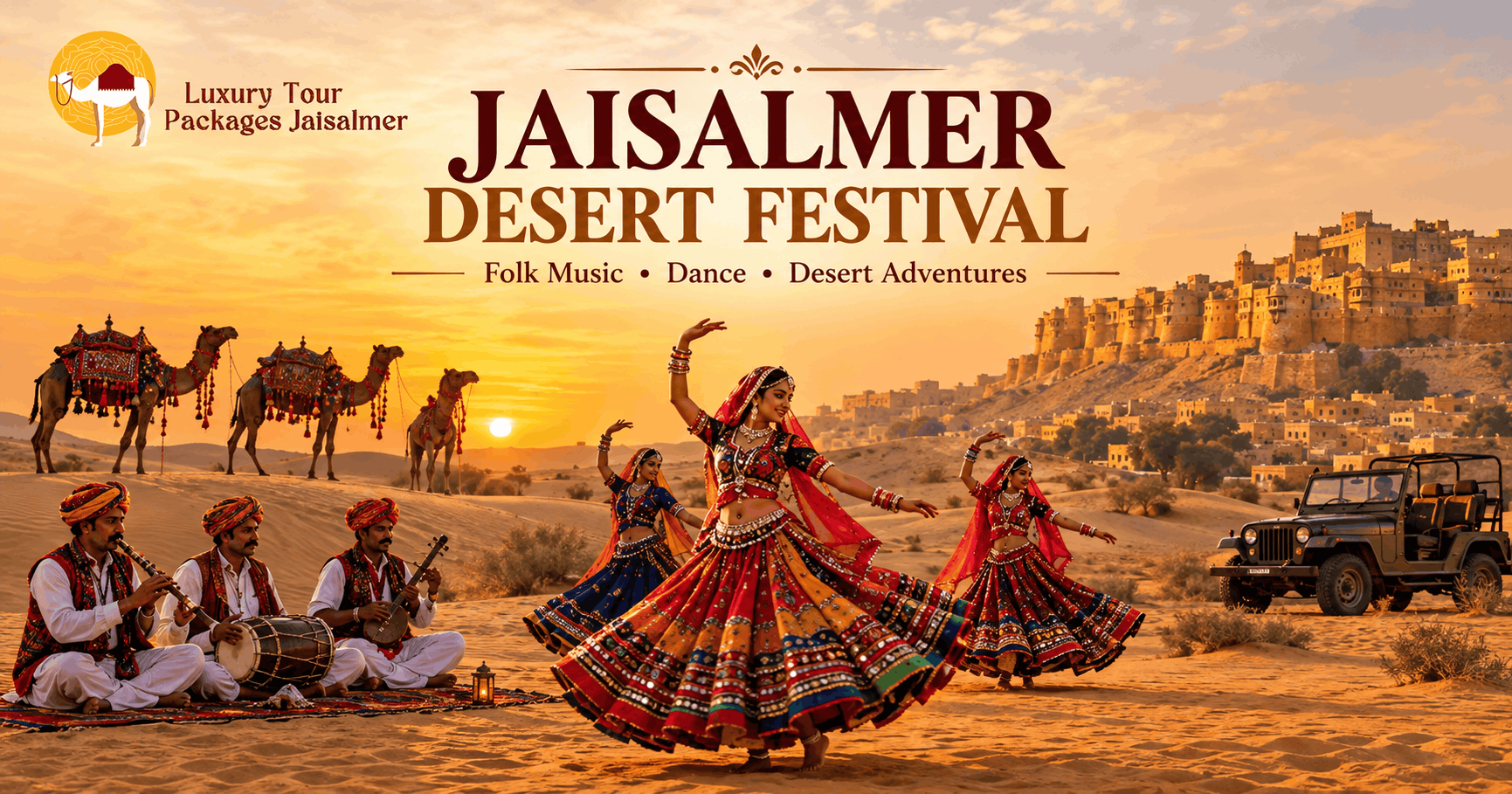

Every February, the Golden City of Jaisalmer puts on its brightest clothes. Turbans in every colour fill the lanes below the sandstone fort, drums echo off the haveli walls, and the Thar Desert becomes a stage for music, dance, sport and storytelling. This is the Jaisalmer Desert Festival, also known as Maru Mahotsav, and it is one of the most colourful cultural events in Rajasthan.
This guide covers everything you need to plan the trip: dates, the programme, folk performances, desert activities, stay options, taxi fares and a realistic budget.
What Is the Jaisalmer Desert Festival?
The Desert Festival is a three-day celebration of Rajasthan’s desert culture, held in Jaisalmer city and on the Sam Sand Dunes. It was created to showcase the music, crafts, costumes and traditions of the Thar, and to bring visitors to the region during the best weather of the year. It grew out of the historical celebration of the founding of the Jaisalmer kingdom by Rawal Jaisal in 1196.
The festival is a mix of three things:
- Cultural performances: folk singing, puppet shows and dances by communities from across the desert.
- Fun competitions: turban tying, moustache contests, tug of war and the crowd-favourite Mr. Desert contest.
- Desert adventure: camel rides, jeep safaris, camp nights and the full-moon finale on the dunes.
For travellers, it is the one time of year when culture, adventure and the golden landscape all come together in one trip.
Jaisalmer Desert Festival Dates
The Jaisalmer Desert Festival follows the Hindu lunar calendar and is timed around Magh Purnima, the full moon of the Magh month. The 2027 festival is set for 18 to 20 February, Thursday to Saturday, with Magh Purnima falling on Saturday 20 February 2027. The 2026 edition ran on 30 January to 1 February, so you can see how the dates shift from year to year.
| Detail | Information |
| Festival name | Jaisalmer Desert Festival (Maru Mahotsav) |
| 2027 dates (tentative) | 18 to 20 February 2027 |
| Final night | Full moon night, Magh Purnima (20 February 2027) |
| Venues | Jaisalmer city (Gadisar Lake, Fort area) and Sam Sand Dunes |
| Duration | 3 days |
| Best time to visit | February, with pleasant days and cold nights |
| Booking window | Book 2 to 3 months ahead |
A note on dates: Festival dates can be adjusted by the tourism authorities. Always confirm the final schedule a few weeks before you travel. Our team can confirm the latest dates and event timings when you enquire.
Why February Is the Perfect Time for the Thar Desert
February is the sweet spot for Jaisalmer. Days are warm and bright, evenings turn cool, and nights on the dunes can be cold. That makes outdoor activities comfortable and star gazing spectacular.
| Month | Day temperature | Night temperature | Comfort level |
| January | 20 to 24°C | 5 to 8°C | Very cold nights |
| February | 24 to 28°C | 9 to 13°C | Ideal for festival and safaris |
| March | 30 to 35°C | 15 to 20°C | Warm, fewer crowds |
Skies are clear in February, so sunsets over the dunes are golden and long. This is also why the festival draws photographers from around the world.
Day-by-Day Programme: What Happens at the Festival
The exact schedule changes each year, but the structure stays familiar. Here is a typical flow.
Day 1: Procession and Opening Ceremony
The festival begins with a colourful procession through the old city. Performers in traditional dress, camels with decorated saddles, and local bands march from the Jaisalmer Fort area toward Gadisar Lake. The opening ceremony follows in the evening, usually with a cultural programme and a welcome by local dignitaries.
What to watch for:
- Decorated camels and horses in the procession
- Rajasthani brass bands and drummers
- Folk artists in full costume
- Evening performances near Gadisar Lake
Day 2: Competitions and Folk Performances
This is the heart of the festival. Expect a long day of competitions and music.
- Turban tying: Participants race to tie the traditional Rajasthani safa.
- Moustache contest: Long, curled, waxed moustaches compete for the title.
- Mr. Desert contest: Local men in traditional attire compete for the crown.
- Camel events: Camel races, camel decoration and camel polo are crowd favourites.
- Tug of war: Local and visiting teams compete.
- Gair and fire dance: Energetic group dances that often continue into the night.
Day 3: Sam Sand Dunes and the Full Moon Finale
The final day moves to the Sam Sand Dunes. Performances, camel events and cultural shows go on as the light turns golden. As the sun sets, the dunes fill with music. The festival closes on the full moon night, when the sand glows under the moonlight and artists perform around bonfires.
For many visitors, this night is the highlight of the entire trip.
Folk Music of the Thar: Voices of the Desert
Rajasthan’s desert music is one of the oldest living traditions in India. At the festival you will hear it live, in its natural setting.
Manganiyar and Langa Singers
The Manganiyar and Langa communities are hereditary musicians from the Jaisalmer and Barmer region. Their songs carry stories of love, valour and desert life. Listen for the kamaicha (a bowed string instrument), the khartal (wooden clappers), the dholak and the sindhi sarangi.
Instruments You Will Hear
| Instrument | Type | Sound character |
| Kamaicha | Bowed string | Deep, haunting, emotional |
| Khartal | Wooden clappers | Sharp, rhythmic clicking |
| Dholak | Hand drum | Warm and driving |
| Algoza | Double flute | Bright, flowing |
| Morchang | Jaw harp | Twanging, playful |
| Sarangi | Bowed string | Soulful and rich |
Why It Feels Different at the Festival
Hearing these artists on a concert stage is one thing. Hearing them under open sky with the dunes behind them is another. Many travellers say the music is what they remember most.
Folk Dances You Should Not Miss
Kalbeliya Dance
The Kalbeliya dance comes from the snake-charmer community. Dancers in black skirts with silver embroidery spin quickly to the sound of the pungi and dholak. It is recognised by UNESCO as part of India’s intangible cultural heritage.
Ghoomar
Ghoomar is a graceful dance in which women in flowing, swirling skirts rotate in slow, rhythmic circles. It is common at celebrations across Rajasthan.
Gair Dance
Gair is a group dance, often performed by men with sticks, moving in circles with great energy. It is a festival favourite and often ends in loud applause.
Fire Dance
Performed at night near bonfires, the fire dance is a striking sight. Skilled performers move with fire in hand against the dark sky.
Chari and Terah Taali
Chari dance features women balancing brass pots with lit lamps on their heads. Terah Taali is a ritual dance where seated performers tie cymbals to their body and strike them in patterns. Both are worth watching closely.
Desert Adventures Around the Festival
The festival gives you culture. The desert gives you adrenaline. Most visitors combine the two. Here are the main experiences to plan, with typical rates for the festival season.
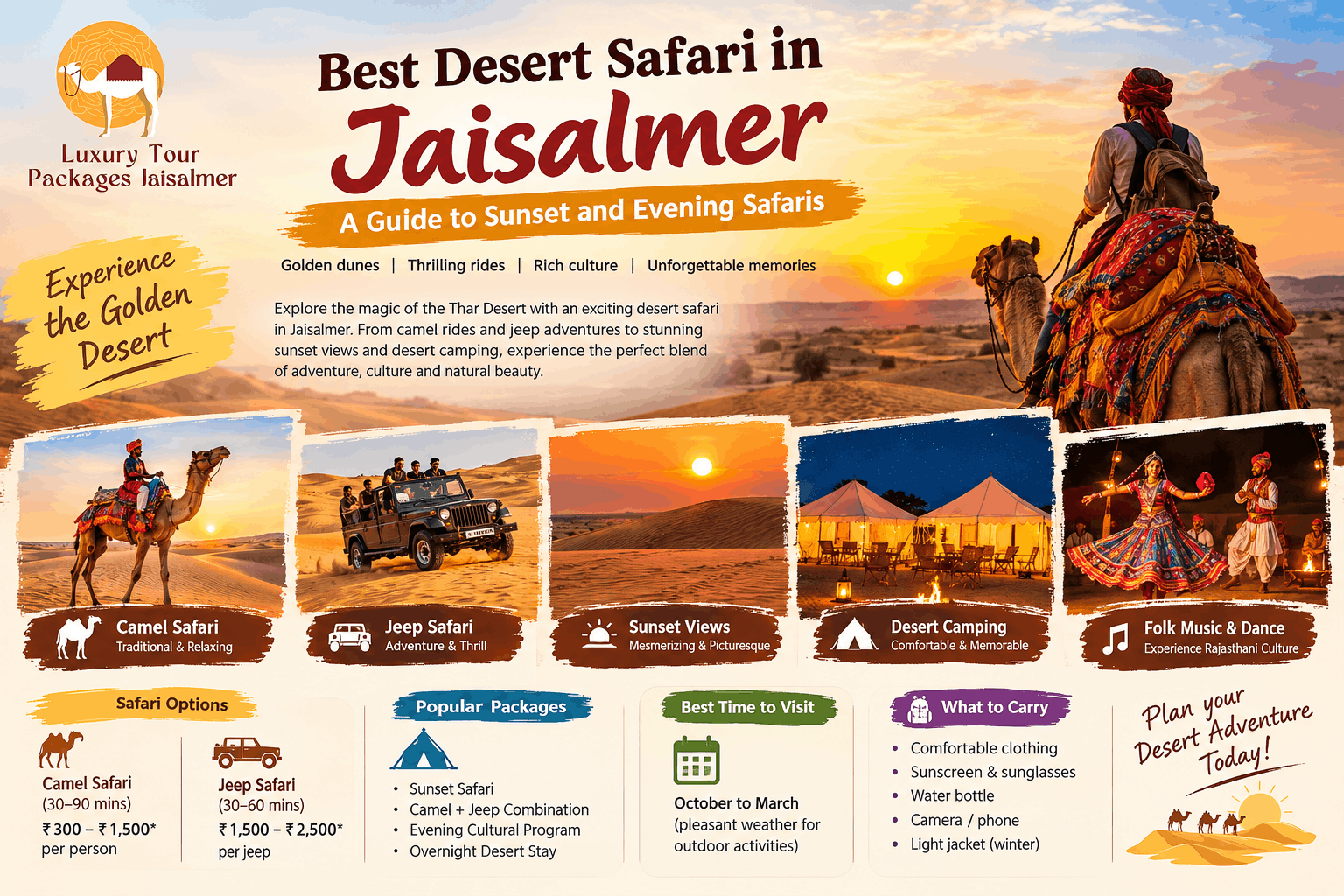
Jaisalmer Camel Safari
The Jaisalmer camel safari is the classic desert experience. You ride across rolling dunes in the late afternoon and watch the sun set over the sand. Longer safaris include a night camp with dinner and a sunrise ride.
| Camel safari type | Duration | Approx. price per person |
| Short camel ride | 30 minutes | ₹300 to ₹500 |
| Sunset camel safari | 1 to 1.5 hours | ₹600 to ₹1,000 |
| Camel safari with dinner | 3 to 4 hours | ₹1,500 to ₹2,500 |
| Overnight camel safari | 1 night | ₹2,500 to ₹4,500 |
During festival days, rates are usually at the higher end. Always confirm what is included, such as transport, dinner and bedding, before you pay.
Best Jeep Safari in Jaisalmer
A jeep safari takes you deeper into the desert than a camel can go in an afternoon. Open 4x4 jeeps tackle the dunes with some thrilling ups and downs. Visits often include a stop at an old village such as Khuri, and a sunset viewing on the dunes.
For the best jeep safari in Jaisalmer, look for experienced drivers, well-maintained vehicles and clear timing. Sunset safaris are the most popular and book out fastest in festival week.
| Jeep safari type | Duration | Approx. price |
| Shared sunset jeep safari | 2 to 3 hours | ₹800 to ₹1,200 per person |
| Private jeep (up to 6 people) | 2 to 3 hours | ₹2,500 to ₹4,000 per jeep |
| Full-day desert and village safari | 6 to 8 hours | ₹4,000 to ₹6,500 per jeep |
| Night jeep safari with dinner | 4 to 5 hours | ₹1,500 to ₹2,500 per person |
Quad Bike in Jaisalmer
If you want speed, a quad bike in Jaisalmer is the answer. Quad bikes (ATVs) are available near the Sam Sand Dunes and are very popular with younger travellers and couples. Rides are short and run on designated tracks, usually with a guide.
| Quad bike ride | Duration | Approx. price |
| Short ride | 15 minutes | ₹500 to ₹800 |
| Standard ride | 30 minutes | ₹1,000 to ₹1,500 |
| Extended ride | 1 hour | ₹1,800 to ₹2,500 |
Safety tips:
- Wear closed shoes and keep sunglasses or a scarf for dust.
- Follow the guide’s instructions and stay on the marked path.
- Do not ride after dark unless the operator provides proper lighting.
Desert Safari Jaisalmer: Combo Experiences
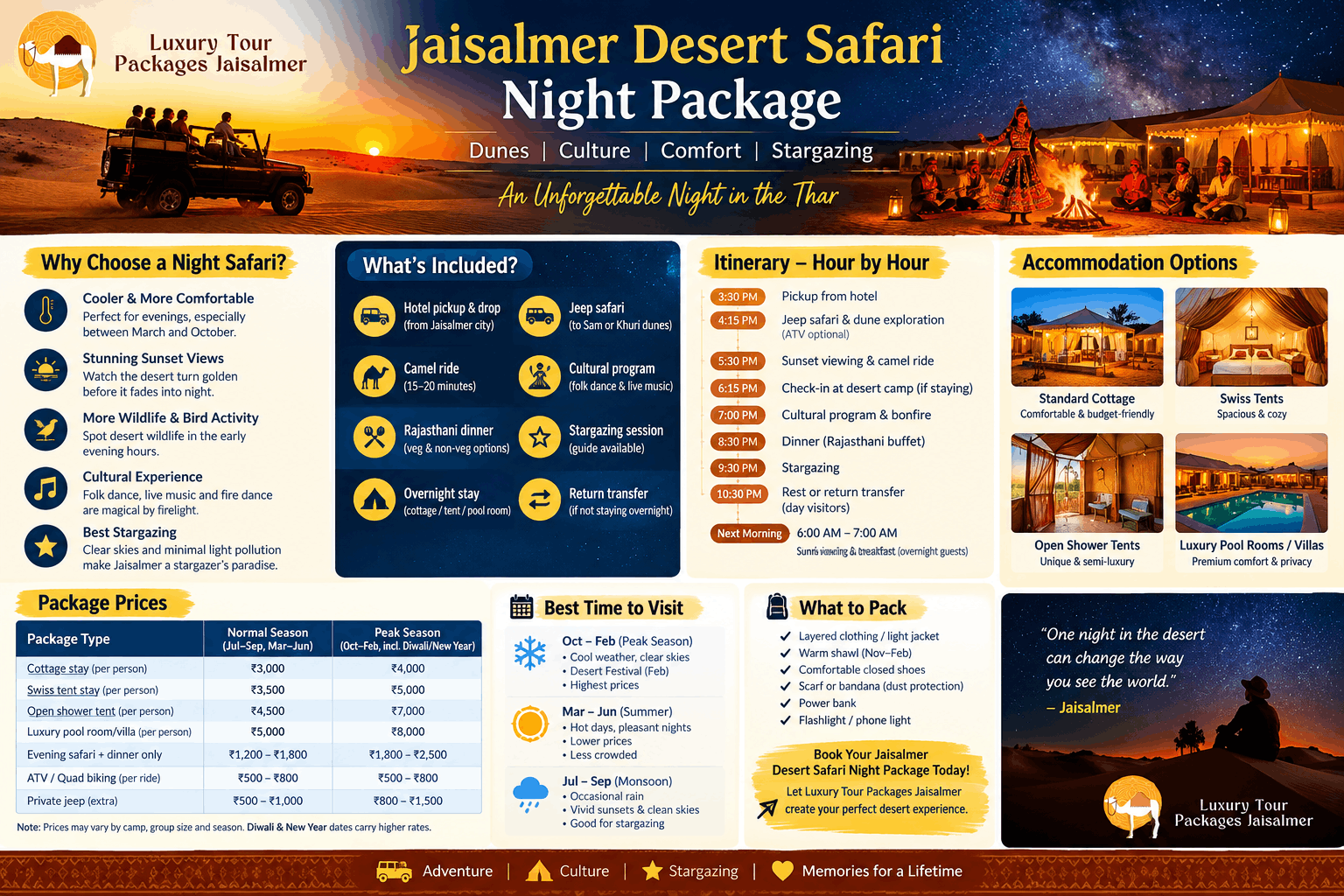
Many travellers choose a combined desert camp in Jaisalmer that includes a jeep ride, a camel ride, a cultural show and dinner at a camp. This is the easiest way to experience several activities in one evening.
| Desert safari combo | What is included | Approx. price per person |
| Basic combo | Jeep, camel ride, sunset | ₹1,500 to ₹2,200 |
| Standard combo | Jeep, camel, cultural show, dinner | ₹2,200 to ₹3,500 |
| Premium combo | Jeep, camel, quad bike, show, dinner | ₹3,500 to ₹5,500 |
A Night in the Jaisalmer Desert
There is no better way to end a festival day than staying overnight in the dunes. Spending a night in the Jaisalmer desert means:
- A bonfire with folk music and dance
- A traditional Rajasthani dinner, usually dal baati churma, gatte ki sabzi, and sweets
- A sky full of stars, far from city lights
- A quiet sunrise over the sand the next morning
The Thar is one of the clearest places in India for star gazing. On festival nights, the full moon makes the dunes glow silver. On darker nights, you can see the Milky Way.
What to expect at night: February evenings on the dunes are cold, often falling to single digits late at night. Carry a jacket, a woollen cap and warm socks.
Jaisalmer Desert Camp: Where to Stay During the Festival
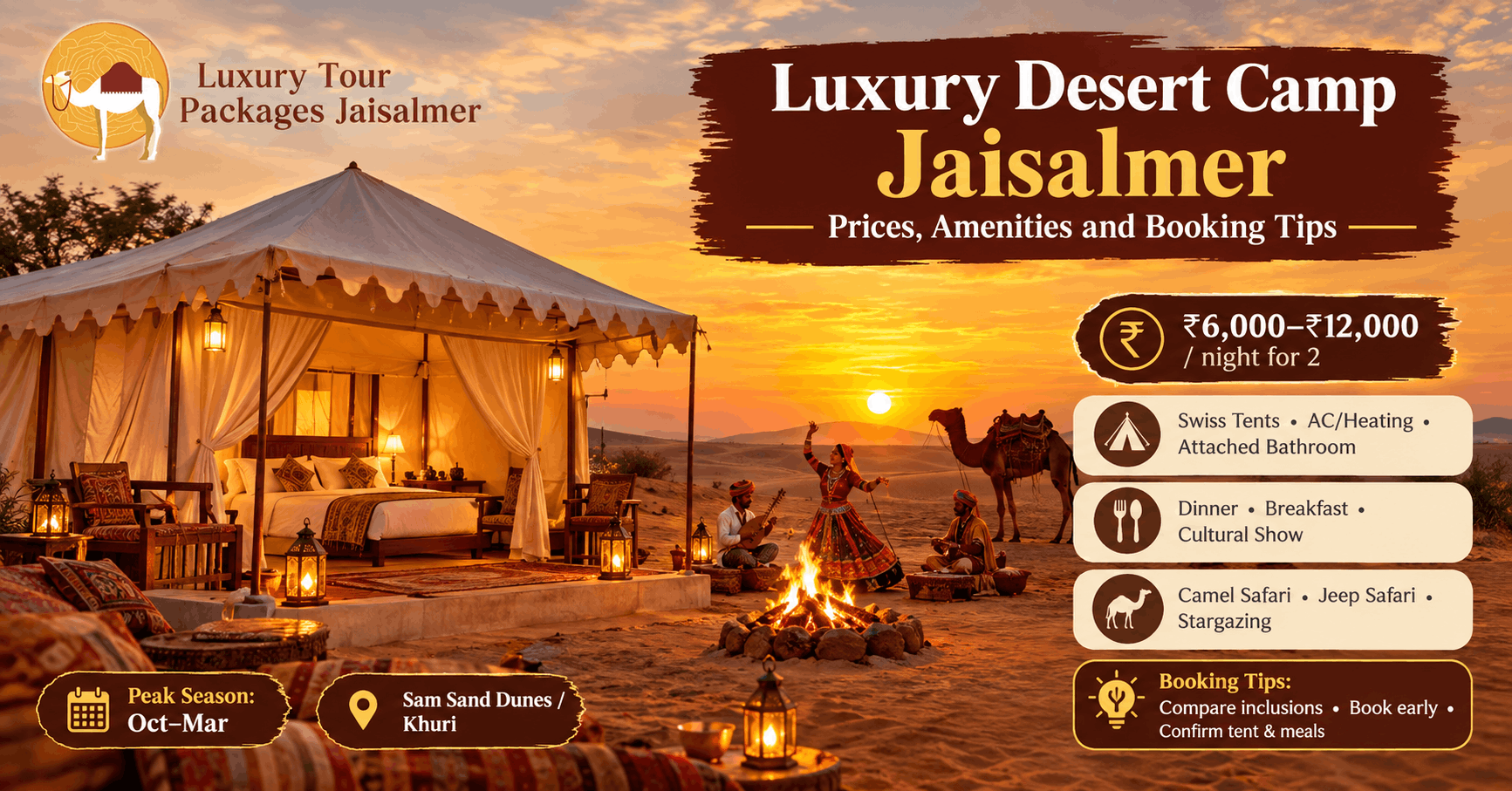
A Jaisalmer Desert Camp is where most visitors spend at least one night. Camps are mostly located around the Sam Sand Dunes and Khuri, a short drive from the city. They range from simple tents to luxury tent stays with attached bathrooms and air conditioning or heating.
Types of Stay
| Stay type | Features | Best for |
| Standard tent | Basic bed, shared or attached bath | Budget travellers |
| Swiss tent | Larger tent, attached bath, comfortable bed | Couples and families |
| Luxury tent | Designer interiors, heater, premium bedding | Honeymooners |
| Cottage | Mud-and-stone style room with modern comfort | Families, longer stays |
| Pool tent or villa | Private or shared pool | Luxury seekers |
Approximate Camp Prices
Prices below are per night for two people, and typically include dinner, breakfast and a cultural programme. Festival nights are priced higher than normal season.
| Stay type | Normal season (per night) | Festival season (per night) |
| Standard tent | ₹2,000 to ₹3,000 | ₹3,500 to ₹5,000 |
| Cottage | ₹3,000 to ₹4,000 | ₹4,500 to ₹6,500 |
| Swiss tent | ₹3,500 to ₹5,000 | ₹5,000 to ₹7,500 |
| Luxury tent with open shower | ₹4,500 to ₹7,000 | ₹7,000 to ₹10,000 |
| Pool tent or villa | ₹5,000 to ₹8,000 | ₹8,000 to ₹12,000 |
As a reference point, a well-known luxury camp in the area may charge ₹3,000 for a cottage, ₹3,500 for a Swiss tent, ₹4,500 for an open shower tent and ₹5,000 for a swimming pool room in normal season. Festival and peak weeks are higher.
What to Check Before Booking a Camp
- Location: Is it near Sam Sand Dunes or far from them?
- Inclusions: Are dinner, breakfast, folk show and bonfire included?
- Heating: In February, a heater or good blankets are a must.
- Transfers: Is pick-up and drop included?
- Cancellation policy: Festival dates can change, so check the terms.
Taxi Services in Jaisalmer: Getting Around During the Festival
Roads are busy during festival days, and parking near the venues is limited. Hiring a reliable taxi saves time and stress. Good taxi services in Jaisalmer offer airport and railway transfers, sightseeing packages, desert drops and outstation trips.
Common Taxi Routes and Approximate Fares
| Route | Distance | Sedan fare | SUV / Innova fare |
| Airport or station to city hotel | 5 to 10 km | ₹500 to ₹800 | ₹800 to ₹1,200 |
| Jaisalmer city to Sam Sand Dunes | 40 to 45 km | ₹1,000 to ₹1,500 | ₹1,500 to ₹2,200 |
| Jaisalmer city to Khuri | 45 km | ₹1,200 to ₹1,600 | ₹1,600 to ₹2,200 |
| Jaisalmer city sightseeing (8 hours) | Local | ₹1,800 to ₹2,500 | ₹2,800 to ₹3,800 |
| Kuldhara and Khaba | About 20 km | ₹800 to ₹1,200 | ₹1,200 to ₹1,800 |
| Jaisalmer to Tanot Mata and Longewala | 120 km one way | ₹3,500 to ₹5,000 | ₹5,000 to ₹7,000 |
| Jodhpur to Jaisalmer | About 285 km | ₹5,500 to ₹7,500 | ₹8,000 to ₹10,500 |
Why Book a Taxi in Advance
- Festival week has high demand, and availability drops quickly.
- Pre-booking gives you a fixed fare with no surprises.
- A local driver knows the best routes and timings for the dunes and the fort.
- You can combine desert safari pickup, camp drop and next-day sightseeing with one driver.
Tip: Ask for a driver who speaks your language and knows the festival venues. It makes a big difference on crowded days.
Must-See Places Around the Festival
Between events, use your free time to explore Jaisalmer. A day of sightseeing fits well with a festival trip.
Jaisalmer Fort (Sonar Qila)
Jaisalmer Fort is one of the few living forts in the world, with homes, shops, temples and guesthouses inside its walls. Glowing gold at sunset, it is the symbol of the city.
Patwon Ki Haveli
A cluster of five grand havelis with intricate carved sandstone balconies. It is a great place to appreciate the city’s merchant history.
Gadisar Lake
A peaceful man-made lake surrounded by temples and ghats. It is often part of the festival programme and a lovely place at sunrise.
Bada Bagh
An old royal cenotaph complex just outside the city, with golden domes. It is a favourite with photographers at sunset.
Kuldhara
An abandoned village about 20 km from the city, with a haunting history. It is an easy half-day trip and a popular stop on a sightseeing taxi.
Sam Sand Dunes
The most famous dunes in Rajasthan and the main venue for the festival finale. Visit at sunset and stay for the cultural show.
Quick Sightseeing Guide
| Place | Best time to visit | Time needed |
| Jaisalmer Fort | Morning or sunset | 2 to 3 hours |
| Patwon Ki Haveli | Morning | 1 hour |
| Gadisar Lake | Sunrise | 1 hour |
| Bada Bagh | Sunset | 1 hour |
| Kuldhara | Late afternoon | 1.5 hours |
| Sam Sand Dunes | Sunset to night | 3 to 5 hours |
Sample 3-Day Itinerary for the Desert Festival
Use this plan as a starting point and adjust it to the final festival programme.
Day 1: Arrival and Festival Opening
- Arrive in Jaisalmer, check in and rest.
- Afternoon: Visit Jaisalmer Fort and walk the old lanes.
- Evening: Watch the opening procession and cultural programme near Gadisar Lake.
- Dinner at a rooftop restaurant with a fort view.
Day 2: Festival Events and Local Sightseeing
- Morning: Visit Patwon Ki Haveli and Gadisar Lake.
- Midday: Watch festival competitions such as turban tying and the Mr. Desert contest.
- Late afternoon: Drive to Sam Sand Dunes for a camel safari and jeep safari.
- Night: Check in at a desert camp, enjoy dinner, bonfire and folk music.
Day 3: Sunrise, Full Moon Finale and Departure
- Early morning: Watch the sunrise over the dunes.
- After breakfast: Optional quad bike ride before checkout.
- Afternoon: Visit Bada Bagh and Kuldhara.
- Evening: Return to the dunes for the final-night festival programme under the full moon, then depart the next day.
Add More Days to Your Rajasthan Trip
If you have extra time, combine Jaisalmer with Jodhpur, Bikaner or Pushkar. Jaisalmer to Jodhpur is around 285 km and about 5 hours by road, a comfortable day trip with a private taxi.
Estimated Trip Budget (Per Person, 3 Days)
Here is a realistic budget for two travellers sharing a room, excluding flights or train tickets to Jaisalmer.
| Item | Budget trip | Comfort trip | Luxury trip |
| 1 night city hotel | ₹1,200 | ₹2,500 | ₹5,000 |
| 1 night desert camp | ₹2,000 | ₹3,500 | ₹6,000 |
| Meals (3 days) | ₹1,500 | ₹2,500 | ₹4,000 |
| Safari activities | ₹1,000 | ₹2,500 | ₹5,000 |
| Taxi (shared cost) | ₹1,200 | ₹2,000 | ₹3,500 |
| Entry tickets and shopping | ₹500 | ₹1,000 | ₹2,000 |
| Total (approx.) | ₹7,400 | ₹14,000 | ₹25,500 |
Festival season can add 20 to 40 percent to stay and activity costs, so keep a buffer. Booking early is the best way to control your spending.
Packing Checklist for the Desert Festival
Warm days and cold nights mean layers are your best friend.
- Light cotton clothes for the day
- A warm jacket or shawl for evenings and the camp
- Woollen cap, gloves and socks for night
- Sunglasses, sunscreen and a hat
- A scarf or face cover for dust during safaris
- Comfortable closed shoes for dunes and quad bikes
- Power bank, camera and extra memory card
- Personal medicines and a basic first-aid kit
- Reusable water bottle
- Cash, as small vendors and some camps may not accept cards
Tips for a Smooth Festival Trip
- Book early: Rooms, camps and taxis sell out around the festival dates.
- Confirm the schedule: Ask for the latest programme before finalising your plan.
- Reach venues early: Good viewing spots fill up fast, especially on the final night.
- Respect local customs: Ask before photographing artists and dress modestly in temples and villages.
- Stay hydrated: The dry desert air can dehydrate you quickly even in cool weather.
- Carry small notes: Tips for performers, cameleers and drivers are appreciated.
- Keep valuables safe: Crowds gather at festival venues, so be mindful of belongings.
- Leave no trace: Keep the dunes clean by carrying your waste back with you.
Shopping at the Festival: What to Buy
Stalls and craft markets are a big part of the festival atmosphere. Look for:
- Mirror work textiles and embroidered bags: Colourful and easy to carry.
- Leather juttis and camel leather goods: Traditional and durable.
- Silver and tribal jewellery: Check for quality before paying.
- Puppets (kathputli): A classic Rajasthani souvenir.
- Block-printed fabrics and bedsheets: Good value and light to pack.
- Spices and sweets: Perfect gifts to take home.
Bargaining is common, so start at about half of the quoted price and meet in the middle with a smile.
Why Book Your Festival Trip With Luxury Tour Packages Jaisalmer
Festival weeks are the busiest time in Jaisalmer, and planning on your own can be tiring. Booking with a local team removes the guesswork. At Luxury Tour Packages Jaisalmer, we arrange:
- Comfortable taxi and cab service with experienced local drivers
- Desert camp and luxury tent stays near the Sam Sand Dunes
- Jeep safari, camel safari and quad bike bookings at fair rates
- Custom itineraries for couples, families and groups
- Airport, station and outstation transfers
Whether you want a simple dune evening or a full Rajasthan tour around the festival, we plan it around your dates and budget. Visit luxurytourpackagesjaisalmer.in or contact our team to check availability for the festival dates.
Final Thoughts
The Jaisalmer Desert Festival is more than an event. It is a chance to hear the real music of the Thar, watch dances passed down through generations, ride across golden dunes and sleep under a sky full of stars. Combine the festival with a camel safari, a thrilling jeep ride, a quad bike run and a night at a desert camp, and you have a trip that is hard to forget.
Plan early, pack warm, travel with a trusted local team, and let the Golden City show you why it is one of the most magical places in India.